Take a florist and a monk and mix well
A writer who could have simply reproduced her parents' remarkable love story tells Caroline Baum why she adapted the recipe.
Charlotte Wood is a very good cook. I discovered this when we met during residencies at Bundanon,
Arthur Boyd's property. We took turns cooking dinner, and her meals were so delicious that they
became a distraction from the work we were both there to do in her case, finish a draft of her second
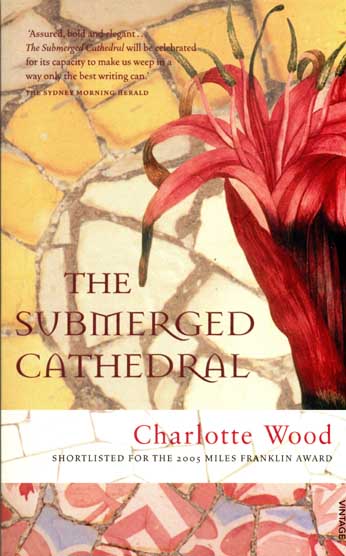
novel, The Submerged Cathedral. Eventually, we had to make a pact to stop consulting recipe books and
drawing up increasingly elaborate shopping lists for forays into Nowra.
Wood's skill at mixing ingredients and transforming them into something else is nowhere more evident than
in the process of writing. Starting with some unusual, personal material, she has created an original dish
with a complex layering of flavours part love story, part spiritual quest, part psychological study. Her imagined
characters and plot, set in the '50s, take their inspiration from the remarkable, true-life story of how her parents
married. John and Felicia Wood met on a ship sailing from Britain to Australia in the late 1950s. Felicia, a
19-year-old florist, had decided to make a new life for herself. John was on his way to join a Cistercian monastery.
The two fell madly in love. They agreed that Felicia would stop off in Perth to sort out things with her new
employer while John headed on to rural Victoria to explain his change of heart to the monks. But after a couple of
weeks, Felicia received a letter from John saying that, after talking with the prior, he had decided to give monastic
life a go, at least for a year. Felicia was devastated, alone in a strange place. A year passed, during which time
John wrote two polite letters to Felicia, signing himself ``Brother Stephen". Felicia could not accept his choice and
wrote to the monastery asking if she could visit. The prior agreed. Felicia walked the last 12 miles to the monastery
from the nearest suburb and, the next day, John asked her to marry him.
Both died young, but Wood, one of five children and newly married herself, still has their letters to each other,
written in the heady weeks that followed their renewed commitment. She resisted the temptation to merely retell
this poignant story, ``because it belongs to them and there was nothing to discover. All I could do was use it as a
jumping-off point to create a new world and a different love story," she says, in the dining area of her rented terrace
house in Camperdown.
``I really believe that when you read something powerful, it comes from the writer exploring as they write. The energy in good writing comes from that risk."
This belief was reinforced when Wood studied creative writing with Sue Woolfe, whose motto is ``write dangerously". ``I wafted around for two years," admits Wood.
``All I had was a monk and a woman who was a florist."
She remembers the family bathtub being filled with flowers on Saturday mornings, before her mother made bouquets
and floral arrangements for weddings. In the end, she substituted Felicia's professional floristry for her character,
Jocelyn's, more gradual interest in gardening. Wood looks out longingly to her own tiny concrete backyard and sighs.
``I've always wanted a garden. The one in the book is a fantasy, but I've always planted a few things wherever I've lived. Writing about a garden is really a metaphor for writing itself: there's the constant doubt, the changing shape, the failures, the way things grow from their own momentum. And you have to weed a lot," she says, rolling her eyes and referring to the numerous drafts completed over the past five years.
She was initially wary of writing a love story. ``The danger was of writing a defrocked-priest, Mills & Boon cliche," she says, with a shudder. But she couldn't resist the mystery of the secret world of the monastery and wrote to the one her father had been a member of asking if she could visit for research purposes. The abbott agreed. ``In my father's day, the Cistercians were a silent order. When I was 12, Dad taught me their sign language, which I loved," says Wood, who spent several hours with the abbott and some of the 20 monks remaining there. One of them remembered her father.
``I was terrified of overblowing the whole atmosphere in my writing, of letting the ritual overpower the narrative so that the result was what one friend called `too many vespers'," she laughs. She is sending the abbott a copy of her book, at his request, and intends to visit again. The darker side of the novel emerges in the mounting tension between Jocelyn and her elder sister, Ellen, who is expecting her second child. When Ellen returns to the family home from London, seeking sanctuary from a physically abusive husband, she interrupts the peaceful idyll of the relationship blossoming between Jocelyn and Martin, a doctor who lives on Pittwater. There are disastrous consequences for each of them.
"The evil sister was less evil when I started," says Wood. "But when I showed an early draft to Peter Bishop, who runs Varuna [the writers' retreat in the Blue Mountains], he said: `This is about paradise and exile and Ellen has to be more of a snake'." Writers go up to Varuna as if going up the hill on a pilgrimage to visit an oracle, says Wood, acknowledging Bishop's importance as a mentor. ``He has the strange gift of being able to see the potential of a mess."
Like Pieces of a Girl, her first novel, The Submerged Cathedral is written in careful, concise, deceptively spare prose, while being eloquent in its visual imagery. Helen Garner once told Wood that she wrote ``richly", but Wood says: ``I'm afraid of opulence. Someone once said to me: `Beware the beauty of language', meaning that you need more than just the ability to make beautiful sentences. So I don't trust that; I know it has to have backbone. Martin's story, of being a doctor who becomes a monk, is all about faith and doubt and how you live with those. In creating him, I've learnt that anguish is
valuable and that the process is the only reward."
© Caroline Baum
First published The Sydney Morning Herald, Feb 28 2004